
Waymo Has Improved Their Safety Messaging
Waymo backs off from their unsupported claim of reducing fatalities

Credit where credit is due — Waymo backed off from its unsupported Saving Lives! claim of "reducing traffic … fatalities” this past summer. This is a good thing.
Some background:1 In an earlier research paper, Waymo made the correct statement that with less than 10 million miles it was too early to determine if they were saving lives or not. (This is still true today, with Waymo having accumulated about 0.47 fatalities in about 100 million miles, which puts them within bounds for roughly-same-as-human but does not support clearly-better-than-human based on available data.) But their public-facing safety web page for a long time trumpeted a misleading and unsupported-by-data public message that they were Saving Lives!
Now they have switched to a message of careful operation and striving for Vision Zero, which is a much more sustainable message than Saving Lives!
Good on them.
The improvement in public messaging on their safety landing page is welcome. Hopefully it is accompanied by a comparable change in messaging to regulators and legislators. There is certainly more they could do to build justifiable trust, but this is a good starting point.
Supporting data:
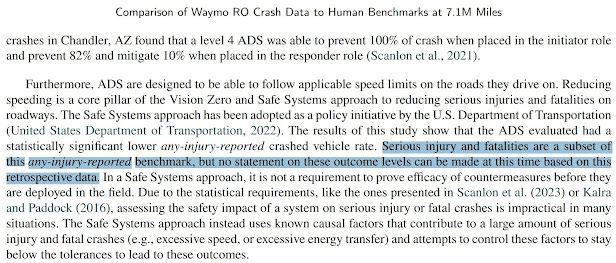
The second half of an older post has the details for their technical claim that saving lives was not supported by data, referencing a paper submitted in December 2023:
Even while that paper was being published, Waymo’s misleading headline message at waymo.com/safety from August 3, 2023 to June 30, 2025 was: “…Waymo Driver is already reducing traffic injuries and fatalities…” (emphasis added):
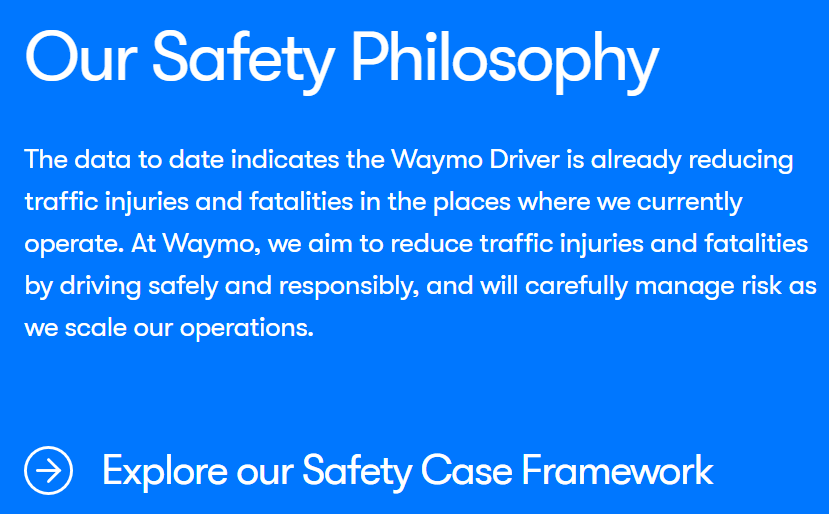
The rationale might have been something like they have a single bin for “injury+fatality” and their analysis showed that bin as better than human. But I confirmed with multiple journalists that this is not the net message conveyed by the way it appears on that safety splash page.
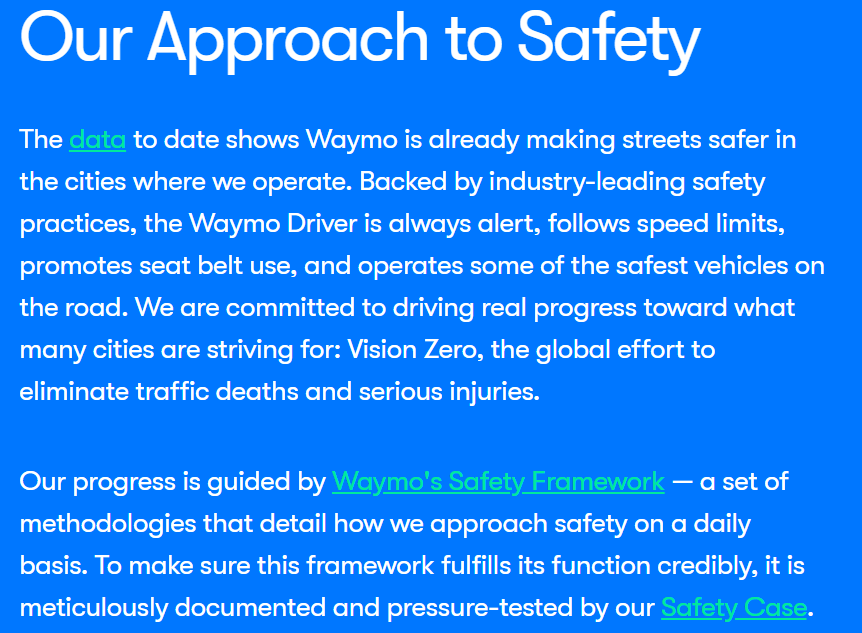
As of July 1, 2025 it changed to a claim of “making streets safer” (presumably based on an injury collision claim alone) and other points. This is arguably OK so long as it is not used as a basis for verbally claiming “saving lives” in front of an audience of regulators or legislators.
Phil Koopman has been working on self-driving car safety for almost 30 years. For more on this and related topics as they applied to any embodied AI system, see his new book: Embodied AI Safety. Chapter 10 describes an approach to sustainable public messaging in support of robotaxi safety, which includes avoiding the Saving Lives! messaging pitfall.
I would prefer to have noticed the change earlier, but I was heads down finishing my new book, and then have been on a crazy travel schedule since. I just noticed it this weekend doing a fact check for some other writing.